March 8, 2007

Educate, Empower, Enlighten

International Women's Day is but a reminder. Everyday should be women's day, and child's day, and human being's day. Everyday we should recall the millions of women who cannot afford to feed their children. The millions of women who do not have access to education. The millions of women living in war torn countries. The millions of women living under oppressive dictatorships. The millions of women being abused by their governments, their employers, their husbands, their parents, their children, and even their fellow woman.

Injustice is not something preserved for women, but women are disproportionately affected by war, poverty, illiteracy, and various forms of abuse.

Women are forced into prostitution, women are raped as a tool of war, women are used to sell cars and chips.

Today I am reminded that no matter how much I complain, I am a lucky woman. I am a woman who did not live in poverty, did not live in fear, did not live in a war zone, or a refugee camp. I have had access to the best education my whole life, and my future is promising. I have not been forced to bind my feet. I have not been genitally mutilated. I have not been forced to marry someone I do not know or do not like. I have not been sold into marriage for political or financial gains. I have not been attacked for endangering my family's "honor".

Today I am grateful for being a Muslim American woman. I could have said that I am grateful for being a Jordanian or Arab woman, but I do not believe that either affiliation has granted me much. I am at times ashamed to be an Arab, ashamed to be Jordanian. I am at times also ashamed to be American. But I'm never ashamed to be a Muslim woman, although in this day and age, it is difficult to disassociate myself from the many who have misused and abused Islam.

I'm ashamed to be a Jordanian woman because my children cannot be Jordanian like me. Not even half Jordanian. I cannot pass my citizenship on to them because I am marrying a non-Jordanian man.

I'm not ashamed to be a Muslim woman because I have been able to practice my religion in the United States without provocation, and without achieving any less than if I had not been Muslim. I do not feel that I have been stripped of any rights or constrained by any religious requirement. I feel empowered by Islam's call for me to educate myself, to be an active member of society. Islam has not limited my freedom. Arab and Jordanian customs have sometimes limited my freedom. American capitalism has sometimes limited my freedom.

I am ashamed to be an Arab woman because my sisters in Iraq are being raped while the Middle East is silent. I am ashamed to be Arab because our mothers in Palestine are starving while women in Virginia and Riyadh are competing over the most expensive handbags. I am ashamed to see that Muslim women are not as educated as their counterparts around the world. I am ashamed to see that my Muslim brothers are not up in arms when one of their sisters is murdered by a raging relative claiming that his honor lies between her legs. I am ashamed that we don't stand up for our own God given rights.

This is what I think about today, and what we should think about everyday.

Let us...Educate, Empower, Enlighten.


Labels: , , , , , , ,

November 22, 2006

Jordanian Student 'Not Guilty' in 9/11 Perjury Case

I first heard of this case Monday from Democracy Now's Amy Goodman who interviewed Osama Awadallah, the Jordanian student who was detained a few days after 9/11. After long hours of questioning and mistreatment over a couple of weeks, Awadallah was presented to a Grand Jury as a "material witness". When they asked him about his knowledge of one of the hijackers involved in the 9/11 attacks, Awadallah could not answer. He had, however, given the FBI all the information they asked for and answered all of their questions just days before. But one can imagine that after days in solitary confinement, questioning by four agents more than 8 hours at a time, someone might just not be ready to give testimony to a grand jury. He was then charged with perjury and was recently found not guilty on all 27 charges by the jury. This is an excerpt of the interview he had with Amy Goodman:

AMY GOODMAN: Did you have a lawyer present?

OSAMA AWADALLAH: No, I didn't have a lawyer. They told me it was going to be a short time, you don't need anyone to be with you. You're going to be fine. Just a few questions and then you will go home. I said that's fine. Remember, at that time, I'm 20 years old, you know? My English at that time was not like I'm speaking to you now. It's completely different. Its been only 2 years in the country, or year and a half...

AMY GOODMAN: Was there an Arabic speaker there?

OSAMA AWADALLAH: No. There wasn't an interpreter there, nor an Arabic speaker. They questioned me all day until 10:00, 11:00, midnight. And I was so exhausted I just wanted to go home. I even was going to answer whatever they wanted in order to just get home and rest. My family didn't know where I am. Everyone was worried. My community was looking for me. And I came at 11:00 and I went to my brother's and there, I told them what happened with me and the second day, the FBI. -- well, actually, on that day, on September 20th, they asked me that they want to come the next day to continue questioning me. I said I just said everything that you want, that I have. Why this other day? They said well there's a couple questions we need to verify. I said ok.

And the second day at 6:00 in the morning, they came to my apartment and I drove with them. I told them it was a Friday—Friday, the Friday service and I told them I had to catch my Friday service. So I hope this won't take much time. They said no, no problem. Then we went there. They started confronting me with things more, you know, in a more high-tone than the previous day and they start to jump on me, this time, there are four people asking me questions not like one. It's like you have a person there and you have four people asking you questions at the same time. So you have to answer. All this pressure and stress that you know, they came in and then at the end, they said you know what? I guess we’re going to go to New York right now. Right now, we’re going to put you on a plane and ship you to New York just--just like this. From there, continued, went to MCC Jail and then to Oklahoma—uh I think San Bernardino Sheriff Jail, then they took me to Oklahoma Jail and then ended up in New York. And until then, that's all that happened.

Read the full interview, watch it or listen to it here.

Labels: , , , , ,

October 4, 2006

LA Times: Jordanian King's Proximity to US is Risky

It's interesting to note all the criticism being directed at Jordan recently, including allegations of mistreatment of laborers as well as involvement in the American policy of "extraordinary rendition". An article in Sunday's Los Angeles Times added to this 'bad publicity', so to speak, and sheds light on the increasing proximity of the Jordanian monarchy and intelligence community to their counterparts in the US.

The article notes an increased detachment between the "too modernized" king and most members of the Jordanian populace. The writer goes as far as saying that the fate of the King Abdullah II may be similar to that of the infamous Shah Pahlavi in Iran. I won't try to summarize the article, but do have a look for yourself. This is an excerpt:
[C]ritics on both sides of the Jordanian divide say the 44-year-old king has failed to garner popular support. Descendants of the tribes that are the monarchy's base criticize the king for failing to abide by tribal customs and losing touch with his supporters. They whisper the name of Abdullah's popular younger brother, Hamzeh. Palestinian groups and activists fear that the government in Amman has gotten too close to Washington, has adopted the Bush administration's with-us-or-against-us worldview too thoroughly and is sliding on human rights and democracy.
As a Jordanian who doesn't live in Jordan, but visits frequently, I, like many others who visit it, would not be able to tell that such a rift exists between the monarchy and the people. In the streets of Amman, Irbid, and other cities, one can barely walk two blocks without seeing the picture of the king plastered on mini-markets and corporate billboards. Talking to Jordanians would not get you to think twice about their loyalty to the king either as direct criticism of the royal family would land you at least a few nights in jail. This is not to say that Jordanian policies are not questioned by the local media and scrutinized by members of parliament. Despite recent developments and initiatives by the King to promote free trade and a new "national agenda" for reform, not much has taken place on the ground that has impacted the lives of the average Jordanians.

I wonder how Jordanians would react to this idea, if they would even want to have any reaction at all. It's interesting to note that the Jordanian blogosphere which usually catches on to any Jordan-related article or story (especially in major American newspapers) hasn't picked up on this one...

In case you don't have access to the article through the LAT website, here it is in full:

Jordan's King Risks Shah's Fate, Critics Warn

By Borzou Daragahi

October 1, 2006

AMMAN, Jordan — A politically inexperienced king takes control of a Middle Eastern monarchy from his powerful father, surrounds himself with U.S. military hardware and spies, loses touch with his people and is finally ejected in a popular uprising.
That was the tale of Mohammed Reza Shah Pahlavi, the pro-American ruler of Iran whose ouster ushered in the reign of Ayatollah Ruhollah Khomeini and three decades of Islamic rule.
Now many in this Arab country of more than 5 million people fear that a similar fate could befall King Abdullah II, the Jordanian monarch who assumed power after his charismatic father died in 1999.
"Until now in Amman we don't have a Khomeini," said one mid-ranking official serving the Jordanian Cabinet. "If there was a Khomeini, then this family would be in trouble."
The king's father, Hussein, deftly balanced his country's contradictory pressures. He paid respects to the conservative East Bank tribes' demands for stability while also attending to calls from the nation's more cosmopolitan majority Palestinians for democratic change.
But critics on both sides of the Jordanian divide say the 44-year-old king has failed to garner popular support. Descendants of the tribes that are the monarchy's base criticize the king for failing to abide by tribal customs and losing touch with his supporters. They whisper the name of Abdullah's popular younger brother, Hamzeh. Palestinian groups and activists fear that the government in Amman has gotten too close to Washington, has adopted the Bush administration's with-us-or-against-us worldview too thoroughly and is sliding on human rights and democracy.
"King Hussein was an artist," said Ivan Eland, for 17 years a staff member of the House Foreign Affairs Committee and now an analyst at the Oakland-based Independent Institute, a think tank. "He was roundly criticized for supporting Saddam [Hussein] in the first Gulf War. But in retrospect, he looked pretty smart.
"The son has gotten more in bed with the United States," he added. "He hasn't been distancing himself from American policy. That has put him in a hole he hasn't been able" to get out of.
Numerous parallels exist between the shah's rule and that of Abdullah. Like the shah's SAVAK security and intelligence service, Jordan's General Intelligence Department, now in a new hilltop complex in an Amman suburb, operates as a "subdivision" of the CIA, said Alexis Debat, a former French Defense Ministry official who is a counter-terrorism consultant and a senior fellow at the Nixon Center in Washington.
By Debat's estimates, the Jordanian intelligence agency receives at least $20 million a year in U.S. funding for operations and liaison work. "They're doing all the legwork for the CIA," he said.
The Jordanians have become one of Washington's closest allies in the intelligence-gathering business, second only to Britain's MI6, counter-intelligence experts say. They are closer to the CIA than the Mossad, Israel's much-touted intelligence agency, which is considered to have too much of an agenda of its own to be completely reliable, Debat said.
Like the Iran of the 1970s, Jordan has become a receptacle of U.S. interests and trade. American aid to the kingdom has totaled $3.59 billion over the last five years, compared with $1.36 billion during the previous five years, according to the Congressional Research Service.
Like the shah's regime, the Jordanian monarchy has surrounded itself with American hardware. Just before Hussein's death, Amman took delivery of 16 advanced F-16 fighter jets. "That was a sort of threshold that Jordan crossed," said Michael R. Fischbach, a professor of history at Randolph-Macon College in Virginia. "They got truly advanced weaponry. It made Jordan have aircraft on par with Israel."
U.S.-made military hardware abounds on Jordan's streets. Jordanian soldiers carrying American-made M-16 assault rifles and riding in olive-green U.S.-made Humvees watch over sensitive military and political sites in Amman, the capital. Convoys of U.S. military transport trucks move in and out of the country.
Perhaps most controversially, say Amnesty International and other human rights groups, Jordan has become an important nexus in U.S. intelligence's subterranean "renditions" network, in which terrorism suspects are secretly detained and interrogated in countries with blemished human rights records. Jordanian officials deny participation in the program.
Many worry that bolstering Jordanian security forces amid widespread reports of abuses against detainees has hampered the country's baby steps toward democratization.
"The security forces are improving at the cost of democracy," said Hamzeh Mansur, a leader of the Islamic Action Front, the main Islamist parliamentary bloc.
Jordanian officials say the security apparatus has been ramped up and civil liberties laws tightened out of fear the country will become a staging ground for secretive cells plotting violent operations in Iraq, Israel and the Palestinian territories. Jordan has also been victimized by terrorism, including the Nov. 9, 2005, bombings of three Amman hotels that killed dozens.
"You have to combat terrorism while it's in its planning stage," said Nasser Joudeh, a government spokesman. "We will not allow Jordan to be used as a scene for any activity relating to non-Jordanian problems. We will not allow anyone to bring militant or extremist ideas into Jordan or export them elsewhere."
But the Hashemite kingdom's evident close ties with Washington and its leap into the U.S.-declared war on terrorism threaten to put the government on what some call a collision course with many of its people, especially in light of a sharp increase in anti-American sentiment after the U.S.-led invasion of Iraq in 2003 and Israel's recent bombing of Lebanon in the Jewish state's war against Shiite Muslim militants.
"Being darlings of the U.S. is considered bad, bad, bad," said a Western analyst based in Jordan who requested anonymity.
Jordanian government officials say the security forces have become less heavy-handed in their approach. "I am liberal-minded," said Maj. Gen. Mohammed Dahabi, the chief of Jordanian intelligence, who says he was appointed in December with a mandate to clean up the service's reputation as well as confront the growing threat of Islamic militants in neighboring Iraq and the West Bank.
However, confronted by the recent allegations of torture, the officials acknowledge that the past casts a long shadow on the country.
"Old habits die hard," said Dahabi, who represents a segment of the tribal-dominated security forces that strongly supports the king.
Few publicly speak out against the king because of a law that can be used to prosecute those who do. "Criticisms of the king and the intelligence forces are strictly taboo and carry serious penalties," says a January 2006 Human Rights Watch report. "Articles of the penal code criminalize speech slandering public officials, criticizing the king and his family, and harming relations with other states."
But Abdullah has emboldened a legion of critics among the country's tradition-minded tribes that are the backbone of the monarchy.
"He talks about information technology and foreign investment, but he doesn't really know his own people," said the government official, who spoke on condition of anonymity because of his sensitive position within the Cabinet.
"The tribes are very upset with him," said the Western analyst in Amman.
"The impression is that he's too Westernized."
Many critics say the monarch has been too busy pursuing a Western agenda instead of forging ahead with a vision for uniting the country, which remains divided between the powerful tribes and the numerous Jordanian nationals of Palestinian descent.
"He has ambitions to make Jordan a modern country," said Jean-Robert Leguey-Feilleux, a scholar of Middle East politics, diplomacy and terrorism at St. Louis University. "You can't do that without the support of the people."

[technorati tags: , , ]

Labels: , ,

August 21, 2006

Reflecting on Six Weeks in Jordan

It feels like I haven't blogged forever since my last post was written during the last hours before I left Amman for Washington D.C. Now that I'm back I hope to be posting more often than I did during my vacation. The long trip across Europe and the Atlantic was very tiring and the recent events in London made things all the more stressful.

We worried about what was allowed on the plane and what wasn't. Thankfully, we were allowed to bring electronics onto the plane (laptop, cameras, phones, etc), but we had to forfeit anything that we had which was made of a "fluid substance." I'm not sure how hard it is for men to do that, but I know it was very inconvenient for me to have to give up my lotion, perfume, hand sanitizer, toothpaste, lip gloss, anti-perspirant, etc. Of course I wasn't stupid enough to throw all that away because I packed some things in my checked luggage, and other things that were banned from the plane cabin I put in a bag that was sent down with the rest of the checked baggage. Although I am usually satisfied with KLM's service, I wondered why they didn't provide us with hygienic essentials that were taken away before boarding. I heard that some airlines were providing passengers with snacks and drinks since they were not allowed to bring on their own. They could've done the same with things like toothpaste, lotion, deodorant, etc.

In any case, we landed safely in one piece and didn't have any trouble at the airport where most employees were surprisingly nice and smiley. Then it occurred to me that I was possibly just looking out for anyone being nice and smiling since much of that was lacking in Jordan :)

On the way home, it took some time for my eyes to adjust to the lush green scenery, the orderly streets, and the generally homogeneous look of suburban Virginia. When I got home, it also took some time for my ears to adjust to the extreme peace and quiet in my neighborhood. No pick-up trucks were roaming the streets honking their horns selling gas and vegetables, no children were to be found yelling and screaming in the streets, no rowdy teenagers were blasting music in their cars or overly aggressive middle aged taxi drivers obsessively honking their horns. It was so quiet that it took me a while longer to fall asleep.

And over the past week since I've been back, I can't help but think about everything that occurred in my month and half stay half way across the world. Nothing had to "happen" per se, just what I observed and heard from Jordanians truly saddened me.

I don't like sounding extremely negative and pessimistic, but it is really hard for me to find something good to say about the state of Jordanian society. Speaking to my cousins about their college experience is utterly depressing. They spoke of incompetent professors, lack of facilities, apathetic students, corrupt administrations, lack of "campus life" and active student organizations, etc.

If colleges were that bad, what was to be said of high schools then? Of course, one cannot speak about high schools in Jordan without considering the Tragedy of Tawjihi. On one side we have families pressuring their children to ace the final 12th grade exam so they can be doctors and engineers. Schools and teachers overload students with work, encourage them to blindly memorize text books and regurgitate the information on the test paper. There is no thinking or analyzing; just memorizing and reciting. And when the results appear, all hell breaks loose. Your final score is announced to everyone, and I mean everyone. If you ace the exam, your life will go on. You will apply to be accepted into any university that takes you, under any major that will accept you with the score that you have, and you will take that road to medicine, computer science, or Arabic studies, whether you like it or not. If you fail the exam, you are doomed. The whole world will know that you are a failure. Even if you were an "A" student your whole life, and you messed up on that one exam, you are a failure. You parents will lock you at home, lower their head when they walk out of the house, and avoid situations where they will be embarrassed to reveal your failing score. If you didn't fail, but didn't score high enough, you will most likely be forced to accept a major you are not passionate about or remotely interested in. You will go on to university lacking the enthusiasm required for students to produce and achieve. You and your peers will not be innovative or creative, and will be afraid of the day you graduate to face the horrors of the job market.

Away from the ailing educational system, you will see a country where as the cliche goes, the rich get richer and poor get poorer. You may stumble upon a neighborhood in Amman with guarded villas, majestic gardens, lavish pools and fountains, and German cars roaming the streets. There is nothing wrong with this picture of course, until you realize that most cities and neighborhoods across the country could not be further away from this image. On those streets, Jordanians worry if they will have enough food and water for the next day. They worry if they will be able to pay the ever increasing taxes on every possible product and service their government provides. They wonder if they will be able to pay for the books or uniforms their children will need for the new school year.

On these same streets, you will encounter some people who pretend to not know anything about law, order, ethics, morals, or common courtesy. Of course I would not want to generalize here, but one too many "incidents" and "encounters" with such individuals makes you wonder if there really is anyone who has respect for the law or maintains any ounce of respect for their fellow human being. There is not much regard for traffic regulations which is evident in the horrifically high rate of fatal accidents in the country. The concept of standing in a line is nearly non-existent, and if one attempts to form one they are easily cut off from every possible direction. The idea of customer service is also a few decades ahead of many institutions and businesses in Jordan.

This is not to mention, of course, the unmentionable: the sad state of political "reform" and political awareness in the country. I don't want to delve too much into this category because it would simply take too long to discuss. What bothered me most about this is how rare it is to find young Jordanians who are interested in or aware of the domestic, regional or international political scene. These 20 somethings can't be bothered much with issues of parliaments, freedom of speech and expression, national agendas, a couple of wars next door, etc. Knowledge of or interest in politics and/or social movements appears to be superficial. You don't find many youth "dedicated" to a cause, whether it be political, social, environmental, or economic. There is a certain segment of young citizens active with religious organizations but it is not a majority by any calculation. I naturally find myself comparing college students in Jordan to those in the US, which is probably an unfair thing to do seeing the huge difference between these two countries. In the US, you'd be hard pressed to find a college student who is not involved in a student organization such as sororities and fraternities, social justice clubs, animal rights clubs, religious studies clubs, cultural clubs, and academic interest clubs. I realize that the environment in Jordanian universities is not as welcoming of this type of activity, but it is also clear that many students are too lazy to take the initiative to push for these programs at their colleges. They would rather not deal with the bureaucracy and trouble it would take to start one of these clubs, but they also do not realize that if they commit to making this happen then it will be easier for students after them to do the same and benefit from their efforts.

To be honest, my intention is not to highlight all these negative aspects of Jordanian society that I witnessed just for the sake of it. It really hurts me to see that we are so behind on many issues despite the potential that our countrymen and women have to make things better. It's not easy to bring about change into society but I strongly believe that if each person becomes aware of the ills of their society and has the will to make it better, then they will find a way to do so, one at a time. I really do hope that the next time I visit my beloved Jordan, I will witness a change, even the smallest positive changes will be good enough for me. As long as I don't come back to reflect on the same problems without any improvements, I will be satisfied.

Here's to hoping.

Labels: ,

August 7, 2006

Five Weeks in Jordan

I've been meaning to write this post for more than 10 days but I got busy with a relative's wedding and of course the ongoing war in Lebanon. My family took a short escape to Amman last Friday and it was truly enjoyable. I say escape because most of my relatives live in Irbid, so we end up having to spend most of our time here visiting and hosting aunts, uncles, cousins, and grandparents. The lingering sadness and frustration about Lebanon did not disappear and made our trip bittersweet.

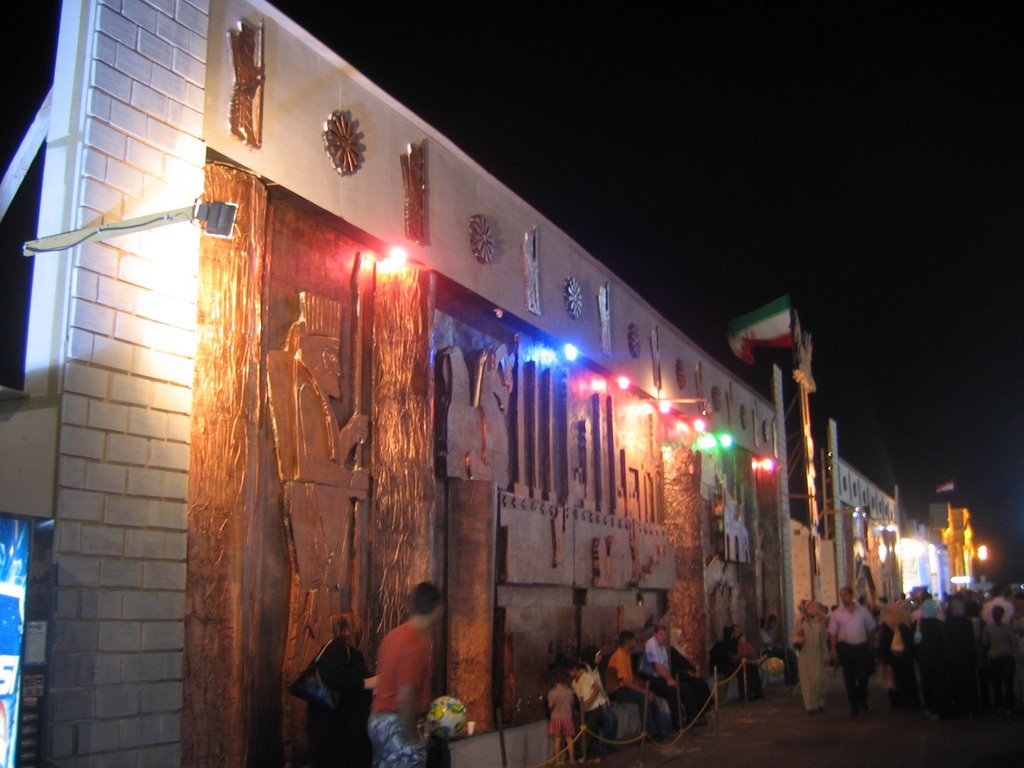
On Friday night, we stopped by the Global Village Festival on the outskirts of Amman which was particularly packed that evening. Nevertheless, the weather was really nice and the exhibits were great. I heard some people saying it wasn't well organized but I found it pretty nice especially since this is only the 3rd year it's being organized.I also got a chance to have my first meeting with a fellow Jordanian blogger the following day. Lina took me to breakfast at Wild Jordan which has a spectacular view of downtown Amman. We had a really great time and I wished we had even more time because there was so much to talk about! I couldn't make it to the Jordan Planet meet up because of my uncle's wedding, but I really hope I can meet some other bloggers before I leave next week. (the view of the Citadel from the top floor of Wild Jordan)

After breakfast, I went with my family and uncle to downtown Amman, "the balad". This was really amazing as I had never been before, although I did read a lot about different landmarks there on the Jordanian blogosphere. First we saw the oldest townhouse in Amman, as well as the old Hosseini Mosque which is absolutely gorgeous.When we passed by this small kiosk-like bookshop and this old man with large black-rimmed glasses stepped out, I immediately recognized it as the one mentioned by various Jordanian bloggers. I was really excited and asked to take pictures of Mr. Abu Ali and his street-side bookshop and as expected he was such a gracious and kind man. I want to stop by again so I can actually have a chat with him. Our long walk through the busy streets made us hungry, so we stopped by another Amman landmark, Al-Quds Restaurant. The traditional Jordanian/Palestinian cuisine was delicious and the antique pictures of Jerusalem all over the restaurant were breathtaking.
The trip to downtown was really the highlight of our short stay in Amman. We stopped by the Global Village another time to check out the exhibits of countries we didn't see the first time and buy more stuff from the Indian, Palestinian, Syrian and other exhibits. Anyone visiting Amman at this time should definitely stop by the village.

With everything going on in the countries next door, I felt it was almost inappropriate to post about anything other than the war. But I also felt the need to document as much as possible from my few weeks in Jordan this year as it is the first time I visit since starting this blog less than a year ago.

[technorati tags: , , ]

Labels: , ,

July 24, 2006

Three Weeks in Jordan

It’s hard to believe that tomorrow I will have been in Jordan for three full weeks. In terms of crossing things out on my list of things to do, places to visit, and people to meet, I have accomplished almost nothing. The reason is simple: when you are in Jordan, you have no control over your time.

No, I’m not exaggerating. My sisters, parents, and I have been working and studying all year, and we like to think that these six weeks in Jordan will be a break from the stresses of daily life in the US. Indeed, we are extremely naïve to assume that this would be the case. I really am holding myself back from pouring out all the complaints I have and elaborating on everything that has annoyed me since being here. But alas, I must let off a little steam.

So back to the time issue. No control over it at all. Every extended family member here wants you to have breakfast, lunch and dinner with them. If you don’t want to, they will swear to divorce their wife or swear that they will not speak to you again. If that doesn’t scare you, then they will just come to have breakfast, lunch and dinner at your home.

Privacy, with regards to every aspect of your life, is non-existent here.

When you are in Jordan, expect your phone to ring at any time in the early morning or after midnight. Expect the doorbell to ring at those times as well. Expect that every person who visits you unannounced has at least one cell phone attached to their ear every other minute of the day. Expect that they will stay for an undetermined amount of time without any regard for any of your own plans. Expect that they will all complain about the economy while they have the newest cell phone, just refurnished their home, and just bought a new car. Expect that most Jordanians will agree with you if you sympathize with the Lebanese and Palestinian people, but that most of them will laugh sarcastically if you suggest that there’s anything you can do to help them. Expect that while the country next door is burning in flames, Jordanian youth are busy watching Haifa Wehbe videos, downloading the latest ringtones, and smoking cigarettes or sheesha. Expect that it is not out of the ordinary for you to be hit with a stroke while your in Jordan for a few weeks if you are not used to living here.

Thankfully, I haven’t had a stroke, yet. It’s because there are other things here that I really do love and admire and it’s those things that help you get through your unusual vacation. It’s the grandmother’s kiss and the aunt’s hug that are always available. It’s the feeling you get when looking out your window watching how simple life is for the goat herder across the street. It’s the smile that spreads across your face when you watch the little sheep play with one another. It’s the nice old man in the mini-market who asks you how your family is doing when you stop to buy a pack of gum. It’s the feeling you get when that old man tells you that all those chocolate bars you just bought cost barely a dinar when you used to pay a couple of dollars for them just a few weeks ago in another country. It’s the fact that you don’t need to go to four different stores to buy ice cream, nail polish remover, tomatoes, and plastic plates; they’re all found in the old man’s mini-market down the street. It’s the aroma of corn and shawerma sandwiches in the busy streets, and the scent of ground coffee I’m smelling right now sitting in the veranda of my grandparent’s house. It’s the generosity of most Jordanians that extends to everyone and is truly overwhelming.

This is what I try to remind myself every minute I am here, to appreciate the small things that one takes for granted all the time. The key word here is try because it gets really hard when you are constantly faced with a reality that is totally different from the one that you are used to living. I think I’ll stop my complaining here, and start praying that I will have more control over my time for the next three weeks so that I can really start doing the things I’ve been wanting to do, seeing the people I want to see, and visiting the places I want to visit. These include meeting with bloggers, visiting the Dhana reserve and other tourist attractions, shopping for things not found in DC, stopping by some museums and in Amman, etc.

I got a kind of late start yesterday when my family went to visit relatives in Ajloun and Eshtafaynah. The drive from Irbid is absolutely breathtaking. We took lots of pictures of the drive-by scenery as well as those of the fruit fields that we hiked through, but the internet right now is not fast enough for me to post them. I'll try to post them on Flickr asap and possibly again on this post sometime later.


[technorati tags: , , , ]

Labels: ,

July 12, 2006

Arriving in Jordan: Thoughts and Pictures

Well I did finally arrive in Jordan late last Wednesday night (Thursday morning to be exact) at around 1 am Amman time after leaving at 6 pm EST on Tuesday evening. I feel like I need to start another blog dedicated to my six week vacation in Jordan because there is so much I have to say about things here, and I haven’t even been here for a week. It’s not like this is the first time I’m here, or that I have been away for years. I was here last July and almost every summer before that since I can remember. Still, it’s different this time because I feel a little more “grown up” and also because I keep connecting everything I see to what I’ve been read on Jordanian blogs for the past 8 months. And finally, every time I notice things that bother me or amuse me about Jordan and Jordanians, I have an urge to run to my computer and blog about them, which isn’t something that I’ve experienced in past summers in Jordan.

Right now, I'm ecstatic because my grandparents' neighbor offered to hook me up to his wireless connection! Yes, wireless Internet access in Irbid, you gotta love it! This will definitely get me back up-to-date with my blogging which I have been missing terribly.

I'm trying my best to point out any positive changes I see in Jordan, but it is definitely hard. Wherever I look, I see people obsessed with their cell phones (err, sorry, "mobile" phones) and the latest ringtones. I hear negativity and see hopelessness. My cousins in college depressed me with stories of incompetence, disorganization, lack of motivation, and a slew of other problems facing my generation here in Jordan.

Nevertheless, I will remain optimistic as I still have a few weeks to explore new places and meet new people in Jordan which I hope will give me some hope for the future of this country.

Until then, I leave you with these pictures from the past week:

clouds from the plane window on the way to Amsterdam


the first i noticed when i left the airport in Amman were the carts thrown all over the parking lot, even though there was a designated area for them to be parked after use. look at how this car is parked totally wrong, and the cart is left in the middle of the parking lot.


the view of Jordan's hilly landscape on the way to Irbid


the usual trip to the traditional Arabic sweets store


sheep grazing across the street from our apartment. in Jordan, sheep receive priority when crossing the street and traveling across the city or village. it's not as common of a sight as it used to be, but I do enjoy seeing that this profession is still alive and well. i didn't, however, appreciate that some drivers are too crazy and in a hurry to give the herd a few minutes to cross. one taxi driver actually beeped at them, as if they would understand!


the view on University Street in Irbid the night of the World Cup; streets were closed to cars because of the heavy foot traffic as fans went out to celebrate the Italian win.


(click images to enlarge)

Labels: ,

July 4, 2006

Final Call for Flight To Amman

I'll be heading to the airport in an hour or so. There must be an easier way to travel, seriously. It's too tiring! Even though I travel half way across the world every year, I still find it fascinating that I will be crossing oceans and continents in a matter of hours (ok, they do need to speed things up, but still). It's a surreal feeling thinking that just yesterday you were in suburban Washington D.C. and the next you're in Amman, Jordan.

So I'm off, and I leave you with a picture of a gift I received recently from a friend who clearly understands my political tendencies :)

(click to enlarge)

Labels: ,

June 30, 2006

Getting Ready for the Motherland... the “Blaad”

With every passing day, the mess in my room and generally on all three floors of my house has been steadily increasing with suitcases and shopping bags sprawled across bedrooms, living rooms, and all over the basement. Yes, it’s that dreaded time of year, getting ready for vacation in Jordan.

In a few days, I’ll be flying thousands of feet above the ground, crossing Europe and the Atlantic, heading for Amman’s “smoke free” international airport. Before I get there, however, the soles of my feet have been working over time, crossing thousands of tiles and dozens of hours in shopping malls and department stores here in the suburbs of D.C. The unavoidable, endless chore of filling the suitcases with gifts for family members, friends, neighbors, acquaintances, the housekeeper… Don’t get me wrong, I enjoy buying gifts for those whom I love, because it’s the thought that counts, right?

Well, not exactly. For a birthday gift, yes, it’s the thought that counts. But coming from another continent after being gone for 10 months (oh the horror), it’s the size and quantity that counts. It’s not like my family members are picky and give us a list of things to buy for them, not at all. We have to guess what everyone likes and wants, and we can’t possibly hand them a little gift bag with a bottle of perfume or a nice piece of jewelry, can we now? It has to be worth it, whatever that means. But really, we enjoy that part, guessing shoe sizes, handbag styles, color preferences, lotion scents, and all that. We love it! And the best part, is the diversity of the reactions of our beloved family and friends who receive the gifts, oh so enjoyable (no, i'm not being sarcastic!)

But c’mon, there’s so much more to traveling than shopping! For me, it’s an endless supply of “to do lists” before I leave. Because here in the US, you can’t just up and leave for a 6 week vacation across the Atlantic. You have to put a stop on the mail that will be rushing into your mailbox. You have to prepay the bills that will land you the calls of credit collectors if you delay them. You have to mow the lawn and trim the grass and make sure someone does it while you’re away so your neighbors won’t call the police. You have to empty the fridge, take out the trash, and make sure the house is spotless so you can return to a nicely cleaned home.

But anyway, let’s fast forward to the plane ride, where I will sit contemplating the next six weeks of my life in Jordan. There is some excitement of course. I miss my extended family and can’t wait to see them. I can already smell my teta’s (grandma’s) great cooking. I can also picture the streets that will take me from the outskirts of Amman to University Street in Irbid. I can already hear the car horns working overtime the minute I step out of the airport. I can smell the diesel fumes. I can picture the latest BMW driving next to the old pickup truck. I can picture the old men sitting outside of their mini-markets and the shawerma stands surrounded by hungry teenagers.

Sitting on the plane for more than 12 hours and another 11 hours in the airport gives you a lot of time to think. Of course I will also be contemplating the changes that will occur during this vacation. An organized and detailed person, I am, who will miss the punctuality and structured life style of the US. I can’t help but say that I will miss “my own space” which will definitely not exist in a Middle Eastern country like Jordan. I won’t have access to the Internet with as much ease as I do here, which will surely drive me a “little” nuts. Nor will I have access to my own car with the ability to drive freely and safely as I do here. I will miss knowing exactly which isle to pick up my cereal and milk from, and swiping my credit card for a transaction as small as a pack of gum. And of course will miss most of the good customer service I take for granted here in the mall, gas station, grocery store, doctor’s office, hotel, gym, library, and of course restaurants of all price ranges.

Ok, ok, I know it’s only 6 weeks! Just think about all the shawerma and falafel I’ll be eating, yum! And of course all the new historical, cultural, and artsy places that I will be visiting thanks to my fellow Jordanian bloggers who have been sharing their experiences and news about all the places to visit and things to do in Jordan :) I hope to be able to meet as many Jordanian bloggers as possible, and any other bloggers visiting Jordan in the next month or so!

I’ll be blogging from there as much as I can and it might include more personal and less political posts than usual as well as lots of pictures, which I hope you will enjoy as well. Ok, back to the packing now, only a few days left!

(I can't just keep things short, can I now? This post wasn't intended to include all those details about gifts and such, but I just like to ramble! Concise isn't in my dictionary.)

[technorati tags: , , , ]

Labels: ,

June 12, 2006

Zarqawi, Israel, and Freedom of Expression in Jordan

The Jordanian blogosphere has been up in arms over the actions of a few parliamentarians who are members of the Jordanian Islamic Action Front (IAF) party. The four men visited the family of Zarqawi and mourned his death, calling him a "martyr." Since then they have been attacked by many people in Jordan who believe that showing such public support for a known enemy of Jordan, the man who was behind the Nov. 11th terrorist attacks, is disrespectful and even treasonous. The response has been quick, which resulted in the arrest of the 4 MP's for investigation and possibly facing serious charges.

Today, a protest was held in front of that Parliament headquarters to denounce the actions of those MP's. Fellow blogger Roba is angered by the lack of diversity, large turnout, and organization at the protest.

The death of Zarqawi and the recent Israeli attack on a Palestinian beach goers has dominated the headlines in the Middle East and the rest of the world. Many people in the Arab world found it hard to deal with both events. They lashed out against Israel for the recent atrocity, which they believe could only happen with the support of the US. The killing of Zarqawi was hailed by the US as a huge achievement, but many in the Middle East are hesitant to express their support for US actions in Iraq.

While they may agree that Zarqawi is a cold-blooded murderer, they feel that supporting his capture would indicate support for the US occupation and denouncement of any resistance to such occupation. The latter is a sentiment few in the Muslim world want to express. With all the suffering faced by their fellow Iraqis, the US occupation has become the enemy, and resistance to such occupation is sometimes glorified despite reservations about Iraqi civilians being the target of these "resistance movements".

So what does this have to do with the IAF and freedom of expression in Jordan?

I believe that these spiraling events are connected in a complex web in the Arab and Muslim mind, as well as in the actions of the governments of the Middle East.

Jordanian officials have allowed a protest to be held for citizens to express their anger at a certain event, the IAF fiasco. There is no doubt that the Jordanian government benefits from such public sentiments against the largest Islamic party which also happens to be the main opposition party in parliament. Just because the government benefits from this fiasco, however, I am in no way indicating that there is a government *conspiracy* to make the party look bad. The MP's apparently have no PR skills whatsoever, and do not seem to care that their actions reflect on the whole party, whether the latter agrees or not. And that they are representatives of the people, and not just their party, so their actions are always scrutinized.

Nevertheless, the fact that the government has nurtured this public outcry and allowed the protest would seem to be a positive step in regards to freedom of expression and assembly in Jordan...right?

Not quite.

The government reaction to this outcry appears to be exceptional and exclusive in nature. One would imagine that any other public outcry against any other government action would be welcomed as well, but that is truly not the case. One would imagine that the public is always allowed to express concern over members of government who appear to be supporting a known enemy of the state and the people. But again, that is not the case.

In the aftermath of the Amman hotel bombings, for which Zarqawi claimed responsibility, he has surely become a known enemy of the state of Jordan and the people of Jordan (ideally). Coincidentally, the people of Jordan also consider Israel an enemy, despite the fact that the government does not. Jordanians consider Sharon and Olmert enemies, despite the fact that the government provides them with the red carpet treatment and official state visits.

In a democratic environment, the people would be allowed to protest both of their enemies and anyone who supports those enemies. They would be allowed to protest in front of the Israeli embassy without being attacked by dogs, water pumps, and riot police. They would allowed to have a referendum on peace with Israel. Their consideration of Israel as an enemy would be implemented by law, and their representatives would be able to truly express the sentiments of their constituents. Of course I realize that Jordan is not a democracy, but it is considered one of the more open and reform minded countries in the Middle East.

My concern is not that people who attack Zarqawi should also attack Israel. That is their personal choice. I don't want to connect the Palestinian-Israeli issue to every other issue in the Middle East (although I could). I simply want to point out that all these issues which mean so much to people in the Arab and Muslim world are continuously exploited in various ways by individuals officially in power or others who have a significant amount of influence on the population. A citizen feels anger or happiness, but he cannot express those feelings unless the government agrees with him. Otherwise, any such expression will result in repression.

I want Jordanians and all other Arabs and Muslims to be able to protest the actions of government officials who support an individual, or party, or state that most consider their enemy. No exceptions.

[technorati tags: , , , ,, , ]

Labels: , , , , ,

May 3, 2006

Free Trade Brings Sweatshops to Jordan

What a coincidence that I just wrote yesterday about the increase in foreign investment in Jordan and efforts to bring Israeli and Jordanian investors together as a way to break barriers. I also pointed out in yesterday's post that these factories, which some consider to be the start of a budding relationship and improving economic conditions, do not have the best reputations in terms of abiding by labor laws.

Today, an article published in the New York Times highlights egregious abuses of labor laws and human rights laws in various factories across Jordan (more from Jordanian bloggers Khadder and Khalaf).

Such abuses are more likely to be found in American factories across China and East Asia, as well as some Gulf countries, which I discussed also in a earlier post.

But to hear that such abuses are now spreading in Jordan, I guess I shouldn't be shocked, but I am, and outraged!

The article is based on a report about Jordanian clothing factories released today by the National Labor Committee, which according to its website, has a mission "to help defend the human rights of workers in the global economy. The NLC investigates and exposes human and labor rights abuses committed by U.S. companies producing goods in the developing world."

THe NLC conducted extensive research throughout various factories in Jordan by speaking to workers, employers, and factory owners in an attempt to get a clear picture of what was really occurring behind closed doors.

Retailers like Wal-Mart, Kohl's, Target, Victoria's Secret, L.L. Bean, and Kmart are all taking advantage of the cheap labor and weak labor laws apparently taking root in Jordan.

The article highlights accusations of human trafficking, Bangladeshi, Indian, Chinese, and Sri Lankan workers paying $1000-$3000 to get to Jordan after being promised decent working conditions, only to find out that nothing of what they were told was true. Their passports are confiscated by some factory owners, preventing them from leaving the country, quitting the job, or even attempting to complain to authorities. When government officials and representatives of the US companies visit the factories for routine checks, workers are forced to lie and not speak of any violations or abuses.

One woman speaks about her experience:
"We used to start at 8 in the morning, and we'd work until midnight, 1 or 2 a.m., seven days a week," said Nargis Akhter, a 25-year-old Bangladeshi who, in a phone interview from Bangladesh, said she worked last year for the Paramount Garment factory outside Amman. "When we were in Bangladesh they promised us we would receive $120 a month, but in the five months I was there I only got one month's salary — and that was just $50."
Not surprisingly, Jordanian officials denied any wrongdoing and insisted that investigations will be conducted. Similarly, representatives of the American companies insisted that when they found problems, they asked the factory to fix them, and that they were not aware of any large scale violations.

Head of the NLC also discussed what he saw in Jordan:
"These are the worst conditions I've ever seen," he said. "You have people working 48 hours straight. You have workers who were stripped of their passports, who don't have ID cards that allow them to go out on the street. If they're stopped, they can be imprisoned or deported, so they're trapped, often held under conditions of involuntary servitude."
As Jordanian blogger Khadder points out in his commentary on this article, such abuses will only serve to plant seeds of resentment in our country and will damage efforts of cooperation between our region and the rest of Asia and other countries. He adds that the losers are the people of Jordan and the evironment, and to a bigger extent, the workers who are dragged to such factories and treated practically as slaves. The only people benefitting are the handful of Jordanian "investors" who are able to evade taxes, as well as the their partners on the other side of the world, the American company owners.

Khalaf criticizes the Jordanian government's decision to grant such companies deferrals on implementing the new minimum wage rate in Jordan. He adds, "Applying Jordanian labor laws stringently towards both Jordanian and guest workers is both a moral and an economic duty. It is unacceptable that these abuses continue under the pretence of encouraging investment."

Needless to say, I agree with both of them, and am ashamed to see that Jordan has reached a point where we are accused of housing sweatshops on our own land. It might appear to many of these upper class investors and government officials that they are indeed helping Jordanians by encouraging foreign investment and thereby helping our economy. In reality, however, Jordan doesn't need this bad publicity and doesn't need to be taken advantage of by companies in developed countries such as the US who know that they cannot overlook the same kinds of violations in their own countries without being penalized for them.

Hopefully, Jordanian officials will realize that this type of mistreatment needs to be addressed immediately before it becomes widespread and even worse in nature.

[technorati tags: , , , , , , , ]

Labels: ,

May 2, 2006

Jordan: Globalization and Privatization... and the Peace Process

An article on the BBC discusses various issues that have come to my attention and piqued my interest over the past few years in the latest investments spreading across my native Jordan.
I heard about new factories being built in various parts of the country, many of which are hiring foreign workers with low wages in addition to some local laborers who are willing to accept the low pay. The products of course do not enter Jordanian markets under any circumstances; they are packed and shipped abroad (mainly to the US) immediately after they are produced. Free trade zones and special economic zones are also becoming popular as King Abdullah II pushes for more economic reform in the country.

The article focuses on the goals of these investors to bring Israel and Jordan closer through economic cooperation. I was surprised to find out that the free trade agreement between Jordan and the US is not as "free" as it appears.

More than a decade ago, Israel and Jordan signed a peace treaty. But it is cold peace - there is little trade or travel between the two countries.

Among ordinary Jordanians, the treaty is deeply unpopular.

Hence this scheme designed to encourage interaction between the two countries.

The jeans being made in Jordan are allowed into the United States without duty or quota restrictions.

To secure that valuable concession, they must have 8% Israeli contents.

One would imagine that such "cooperation" would at least involve some benefit for Jordanians, businessmen or laborers. As the article states, that is simply not the case. The majority of the factory owners are not Jordanian, and most of the workers are foreigners. From what I heard, they are as diverse as Chinese, Indian, Russian, Filipino, Taiwanese, etc.

As in many countries, including here in the US, foreigners are more willing to take on menial jobs that pay less because the remittances they send back home are worth much more than in the US. Jordanians aren't any different, except that many more Jordanians are unemployed and poor than Americans. However, I would disagree with the article regarding the cultural barriers, which I believe are much less prevalent today because of the real need for money to come into the home, even if that means the wife/daughter/sister has to work.

Many Jordanians are reluctant to take on jobs in which the basic wage is only US$80 a month. But there are cultural issues as well. Jordanian men are cautious about allowing women to go to work especially for a foreign boss.

This should not be surprising, seeing that the cost of practically everything in Jordan is continuously on the rise, most recently fuel prices. An article in the Jordanian newspaper Alghad featured on Jameed raises questions about the conditions under which laborers are required to work. The woman discussed in the article is paid a mere 95JD ($135), most of which is spent on transportation and personal expenditures which barely leaves anything for the family. The 25-year-old Jordanian woman explains that the only reason one would seek to work under such conditions for such little pay is they are "running away from starvation." Another woman who works at a similar factory explains that the "stigma" of not allowing women to work has largely disappeared in many rural areas.

The government officials and businessmen behind these efforts seem to think that it might bring about a change in the Jordanian perspective towards Israel. Having similar economic interests should make people forget about politics, right? Well, not exactly. For the businessmen who come from the upper echelons of Jordanian society, that might be possible. But for the average Jordanian (one likely to have roots in Palestine), opinions on Israel will remain the same.

Despite the problems, Montaser Oklah, of the Jordanian Ministry of Industry and Trade, extolled the virtues of the scheme.

"Politically speaking, it is an excellent tool devised by the United States to privatise the peace process," he explained.

"What is meant by that is to allow people from both sides - the Jordanians, the Israelis as well as the Palestinians - to feel and realise the benefits of the peace process."

But even he admits it has done little to change attitudes in Jordan towards Israel.

"When you go out into the streets and speak to the average Jordanian citizen, he or she will start talking about the number of people that are being killed, the number of bombs that are being exploded and they will not tell you anything about the new jobs being established, about the total exports that have been boosted as a result.

The article ends on a less than optmistic note, leaving one sorry for Israel because its efforts in attempting to pursue economic ventures with Arab countries have not proven very successful.

Although the general "Arab street" would be against extensive economic cooperation with Israel, in reality, most Arab leaders would jump at this opportunity and would much rather put politics aside in favor of $$$.

For Jordanians, these investments don't seem to be bringing much change or "development", as many of these factories do not even provide safe working conditions, health insurance, social security, and other problems related to delays in salary payments as mentioned in the Alghad article. The head of the union of workers in one region, Fathallah Alomrani, suggests that the minimum wage be raised to at least 150 JD.

Today, the Jordanian government decided to raise it to from 95 JD to 110 JD, a good start, but not anywhere close to what Jordanians really need to be living a descent life.

It seems like we will just have to "wait and see" how far such economic reforms will go and if they really will benefit the average Jordanian.

[technorati tags: , , , , , ]

Labels:

April 18, 2006

Arab Countries Snub Hamas...Again!

Last week, Egyptian Foreign Minister Ahmed Aboul Gheit turned down a meeting with Palestinian Foreign Minister Mahmoud al-Zahar because he was "too busy" and "could not make time" to meet his counterpart. Most journalists and political analysts considered this an excuse to avoid meeting with the al-Zahar who is a member of the controversial Hamas party.

This week,
Jordan has announced that it will cancel the planned Wednesday meeting with al-Zahar after it accused Hamas of "smuggling weapons" into Jordan, hinting in a separate announcement that the weapons found were to be used to attack "vital" Jordanian targets.

This is clearly another excuse for the Jordanians to avoid a controversial meeting with members of Hamas. Both Jordan and Egypt should be ashamed of themselves, as they are rejecting meetings with members of a democratically elected party representing the Palestinian people. Had it been a meeting with a low-level Israeli politician, the red carpet would have been rolled out for them without any objection. These are the same countries that did nothing during the Intifada (2000-2003) in removing ambassadors or refusing to meet with Israeli officials.

Qatar, a country willing and able to host the Asia Games, has generously donated a whole $50 million to the Palestinian Authority. Let me repeat, FIFTY MILLION BUCKS, one Qatari prince can shake his ASS and this amount will come rolling out of his pockets. Mind you, this is the same country that is willing to plop down $600 million just for the residential project that will house the players visiting the country in December. Forget the other few $BILLION$ that will be needed to fund the rest of the games, which are the largest after the Olympics.

Besides Qatar, only Iran and Russia have offered aid assistance to the Palestinians. All of these donations however, do not cover a fraction of the monthly needs of the PA to pay government salaries and to maintain a semi-government system. The Arab League ministers tried to come to an agreement to provide $55 million to the PA on a monthly basis but that is yet to be confirmed.

Arab leaders, despite their diplomatic public statements, want Hamas to fail miserably. They want to tell their populations that dictatorship is better for them...Look what elections did for the Palestinians...You want Islamic parties? This is what Islamic parties do, they fail. Democracy doesn't work for you Arabs. You're better off with dictators like us.

And the US and EU? Well, they're basically spitting in the face of Palestinians and Arabs in general by encouraging them to pursue democracy and free elections, but withdrawing their support when those elected do not float their boat. We don't need your damn help, we don't need to keep begging for your money, and we don't want to be blackmailed just because you offer us some leftovers after you give the billions to Israel. We want you to leave us the hell alone and let us find a democracy that fits OUR needs and OUR traditions and OUR people's interests.

In the end, it is the mothers of Palestinian prisoners, the families of those brutally killed by Israel, and the rest of the Palestinian population imprisoned and starved that will suffer from these "snubs" and "diplomatic gestures."

Shame, shame, shame!!!

[technorati tags: , , , , , , , ]

Labels: , ,

April 17, 2006

Dummies and Idiots...Definitely *not* referring to Jordanians

I think you can tell a lot about a person by the kind of books they read...especially if they tend to have a few from the "for Dummies" series or the "Complete Idiot's Guide" series. These popular self-help books are all over the place and they cover *thousands* of topics ranging from how to play golf, how to type, what is catholicism, how to reinvent yourself, how to get published, and the list goes on and on.
Anyway, I looked around my room today to find that I have checked out a bunch of these books from the library over the past few weeks. So, what do these books say about me?
- The Complete Idiot's Guide to the Perfect Interview: I'm looking for my first full-time career job and, yes, I'm reading this book to get tips on how to nail my interviews ;) This book was helpful although I've been reading a lot on this topic so much of the information is the same. The presentation of the materials and information in this book, however, is much better than others.

- The Complete Idiot's Guide to Microsoft Excel 2000: One of my interviews required me to take a simple Excel test so I checked this one out to remind me of what I took in highschool because I apparently haven't used Excel during college. I didn't have the patience to read through most of this book, so I just called a friend and he gave me the lo down on Excel.

- Office XP for Dummies: The same interviewer also wanted to test my Microsoft Word skills, and although this program has been my best buddy throughout college, I still felt the need to browse through this one to see if I was missing anything. Of course, I was not aware of every useful icon and avenue in XP, but I'm still working on it.

- Scrapbooking for Dummies: My somewhat new hobby I guess. A friend introduced me to this "universe" of scrapbooking (using decorative material to make a book of memorable photos pages), and I really have to admit that I had no idea this even existed on such a large scale. It's a freakin' industry and it's definitely booming! But I think that this hobby of many (women) has been overly commercialized like everything else in America. Anyway, it's fun so you should check out this book to get a start if you're interested!

I think it's great that we have these resources here. Although for some subjects these books address tend to be shallow (ie: The Complete Idiot's Guide to Middle East Conflict), for more practical things like golfing or buying a house, they can be very helpful.
It's funny that when I first came across these series a few years back I was kind of shocked to see them calling the readers "idiots" and "dummies" but then again that's definitely eye-catching. I wondered what would happen if I bought a book like this for a friend or relative in Jordan. An awkward moment might ensue that would sound a little like this:

me (handing over the book): hey, i got you this book cuz i thought you would like it.
jordanian (looking at the front cover, eyes slowly getting bigger and jaw dropping)
me: it's about how to...
jordanian (interrupting): excuse me?! shu shayfeetnee 7mar ana? mfakreetni idiot willa dummy? la shukran...
me: but wait, that's just the name of the series, there are lot of books like this, don't take it personally, i have them too...
jordanian (shoving the book back in my hand): ma3lesh ma3lesh, ma biddi. wa7deh amreekeieh shayfe 7alha 3alayna, gal idiot gal... wallahi 3al!

Mind you, this isn't a diss on my fellow Jordanians. I think most Arabs would have the same reaction. Not because they're rude and don't accept gifts, not at all. But because the term "idiot" or "dummy" would really be offending, even if it is meant as a joke. It's hard to take jokes when they are on you, especially when it's something you haven't seen before. Jordanians just need to stop taking everything so seriously :)

[technorati tags: , , , , ]

Labels:

November 23, 2005

11/9 in Amman...what do we do?

The events are not on the front pages anymore...the wedding doesn't make headlines in the evening news. But the reality of the situation still exists. Bombs still go off in crowded police lines in Iraq, and who knows where it will be next...
When I first heard about the bombings in Amman, I was really surprised. Unlike in other places, like Bali or Sharm el-Sheikh where there were previous similar events, Jordan has been very quiet, despite the fact that it's surrounded by the worst current conflicts in the ME and two of the most oppressive regimes. Israel/Palestine and Iraq. Saudi Arabia and Syria. And now Syria has some "drama" too. Stupid to think that something like this wasn't about to happen, really.

When it happens to your country, though, it's different. Even for me, and I'm not an apologetic person when it comes to targeting civilians; I've been angered by all the previous random terrorist attacks and never believed they were justified. But it was in Jordan, my uncle works close to one of the hotels. It could've been my cousin or friend... It didn't hit me as hard as 9/11 since I live 20 mins away from the Pentagon, but it hit me hard. I'm human, and we all tend to relate more to "our people" whether it's in terms of gender, race, ethnicity, cultural group, age group, etc.

Let me break down the feelings...

Anger: at the perpetrators mainly. at the government for failing to protect its citizens. at those individuals, many from my own country, who gave excuses for previous terrorist attacks.

Sadness: for the victims. for the state of our world. for the lack of peace and security in almost every corner of the universe. whether from terrorism, hunger, occupation, unemployment, disease, homelessness....

Frustration: because the perpetrators kept getting away. the real bad guys kept lurking somewhere in the background. this was not relieved that much after the would-be bomber was caught. we don't know what she told the police, if they have any evidence to catch zarqawi, what they will do to her, etc.

Cynicism: at the protests that occurred in the streets of Jordan. Not that I don't agree with their condemnation of terrorism and Zarqawi...but because this strong reaction was not seen when similar attacks took place in the region and elsewhere.

But then again, did Americans really give a damn about terrorist attacks before 9/11? Did the majority of the population know about or care to give a damn about the atrocities committed (directly and indirectly, overtly and covertly) by the US government and other allies of the US? Since when did we care about Afghan women and their oppression by the Taliban?

I immediately came the realization that from the horrors of the attacks, something good may emerge. Maybe Jordanians, and other Muslims and Arabs, will begin to realize that there are some terrorists who are blinded by their ideology of ignorance. The last person I want to sound like is Bush or one of his henchmen. I don't want to say, "we told you so. terrorism is blind. you should always condemn it. they hated you because of your freedoms" or some BS like that.

BUt really, we need to do some serious self-reflection. Where did this Zarqawi come from? and OBL? and his followers? and the 9/11 hijackers? How were they brainwashed and convinced? Did their leaders use Islam to justify their actions, and if so, how could a sane person fall for that?

I seriously believe that we as Muslims need to take a closer look at our communities, we need to stay blaming others, and we need to take the initiative to solve our own problems. Muslims are not infalliable, nor will they ever be. And just because there may be some bad apples in the bunch doesn't mean we can't weed them out. The key component is US, WE, not THEM. We need to take care of our own internal issues. If we have individuals who interpret the Quran without much knowledge of it, who have their own agendas, who have personal interests, who may think that they are all-knowing about Islam, then we need to question them. How are they reaching our children? Why are they pushing their extremist ideas on to them? Why is it that we can't be responsible for what our teens listen to, who they interact with, who preaches to them? Parents need to be more active. I want a grassroots kind of change. I don't want the Jordanian police to be spying in mosques and kicking out 'controversial' imams. I don't want the US to be providing help with intelligence to the Jordanian government. This will not end terrorism. It will not end Islamic fanaticism. We need to bring the change from with in.

No, I"m not calling for an 'Islamic revival' or 'revolution'. What I'm taking about is something that is so simple that it can't even be called revolutionary. We need to think.
Think about what we are told, question what we are taught. Not for the sake of questioning, but for the sake of not blindly following.

It's so hard to say what I think. We can't just accept the authority that tells us what Islam is. Each of us has been endowned by God with the necessary brain power to rationally interpret the Quran which is the source of laws and human regulations within Islam. Yes, we need some help. We need to read books to tell us the context of verses. To elaborate on them. Of course. I'm not rejecting or condemning the Islamic scholars who dedicated their lives to the study of religious texts. However, we need to not just follow one individual blindly. I read an interpretation, I should realize that it's simply that, an interpretation. A human being's interpretation. There are other human beings who interpret, and even though I can't read all of them, I shouldn't just take one for granted. I should make more of a personal effort to understand the Quran, the religion that tells me not to kill and murder and terrorize. It's my responsibility. I will be held accountable. And when I do something against it, I will be held for that, not the "imam who told me."

Some people will say, don't question, it's haraaaaam. Wrong. First of all, saying this is haram and that is not, that's a problem within itself. Questioning for the hell of it, for wasting a person's time and energy, that's messed up. I say don't question, but reflect on what you hear, what you read. Make an effort to find out for yourself what it means. But also use the knowledge of those who have studied these texts for ages. Use both.

Use common sense. Indiscriminate murder doesn't make sense. Whether it's committed by an individual, an organization, or a state. Wrong is wrong.
Murder is wrong.
Oppression is wrong.

MY hope is that Jordanians learn from this event. Learn not to blindly follow religious or political authority. Protesting and cussing out Zarqawi ain't gonna solve it. Loving the king and waving his picture ain't gonna solve it. It takes individual committment and community involvement. We need to bring back the essence of Islam, peace.

Wassalamu Alaikum (peace be with you).

Labels: , ,