December 10, 2006

On "Desert Muslims"

Don't you love it when someone tries really hard to defend us poor, miserable, uncivilized bunch of Muslims and Arabs by indicating that "we're really not THAT bad"? I especially love it when a "seasoned" journalist or politician makes this attempt. This is how I read Nicholas Kristof's editorial in today's New York Times entitled "The Muslim Stereotype".

Kristof is in Brunei, an exotic predominantly Muslim Southeast Asian country, where the "sultan has two wives... women can drive... and young people can flirt together in cafes". There he declares that he "find[s] the common American stereotypes of Islam profoundly warped." One might assume that some good will come out of this piece, right? That Kristof will declare once and for all that Muslims are not terrorists and they don't live in the desert. Well, not quite.

In an attempt to indicate that the international media focuses too much on Arab Muslims (where most of the terrorists come from), Kristof makes a failed attempt at highlighting the "good" that comes of out of the predominantly non-Arab Muslims around the world, and specifically in Asia. He seems to have just discovered that Indonesia is a democracy and that Bangladesh has had two female prime ministers.

He writes that the West is really tried of looking at an Arab world that "sometimes seems to put its creative juices mostly into building better bombs". Someone help me here, please. When was the last time you saw an Arab country building an arsenal of weapons to protect itself? You'd think he would be referring to some of the most powerful nations in the world whose stockpiles of weapons continue to swell and their victims can be found in Iraq and elsewhere.

Oh wait, maybe he was referring to Iran's nuclear weapons program? But Iran is not Arab, or did Ahmedenijad turn it into an Arab state while I was sleeping? Well then he must be talking about suicide bombers! How could I forget?! How creative does one have to be to build a suicide belt? It's really an insult to say that all of Arab "creativity" is focused on bomb-making. If anything, suicide bombs represent a lack of power and a resort to cheap materials to create weapons that are used to attack Israeli checkpoints and Iraqi markets. If they were really creative, Arabs would be building stockpiles of conventional and nuclear weapons to rival the threat posed by the very creative Israelis.

Kristof is right in the sense that "Muslims" are often confused with Arabs, and subsequently, non-Arab Muslims get lost in the picture. This is not a fault of Arab Muslims, however. It's the fault of an ignorant media that chooses to reinforce this misconception. It's also true that most of the news headlines today focus on the Middle East, but that should not translate into "everyone involved in those conflicts is Muslim". He concludes by making an absurd correlation between the level of religiosity and modernity in the Muslim world and the geographical location of the country involved.
The plain fact is that some Muslim societies do have a real problem with violence, with the subjugation of women, with tolerance. But the mosaic of Islam is vast and contains many more hopeful glimpses of the future.

There is a historic dichotomy between desert Islam -- the austere fundamentalism of countries like Saudi Arabia -- and riverine or coastal Islam, more outward-looking, flexible and tolerant. Desert Muslims grab the headlines, but my bet is that in the struggle for the soul of Islam, maritime Muslims have the edge.
This is not in defense of the wrongs that take place in the name of Islam across Arabia. One cannot deny that problems do exist, many of which are caused by oppressive dictators and ignorance of Islamic teachings. But to attempt to highlight the "goodness" of Asian Muslims by overemphasizing the faults of Arab Muslims does nothing to help the ever increasing stereotypes and accusations hurled at Islam on daily basis. Kristof would be well served if he made an attempt to take a closer look at the lives of those "desert Muslims" and the reasons behind the problems he indicated.

After doing that, he should come by to Washington D.C. where cab drivers and children crossing streets are gunned down everyday, where women wait in alleys at night to be picked up, and where airlines pull passengers off planes because they pray to their Lord. Seems to me like a healthy dose of violence, subjugation of women, and intolerance right here in our nation's capital. See you soon, Mr. Kristof.

[The full article is only available to TimesSelect members. If you can't access it, email me and I can send it to you. A simple blog search will also lead to blogs that posted the piece.]

Labels: , , , , ,

November 14, 2006

Talking About Palestine and Israel, in America

A few interesting articles caught my attention over the past few days, all related to the way Americans talk about the "Israel Palestine issue". That's about the only similarity between these articles; one about pro-Israeli evangelicals, another about a former president's view of Israel, and the last about college students bickering about the conflict.

David D. Kirkpatrick writes in the New York Times today with a provocative headline, "For Evangelicals, Supporting Israel is 'God's Foreign Policy' ". Kirkpatrick discusses the rise of popularity of pro-Israeli evangelical Christian groups recently, especially during the war on Lebanon this past July. One such group--the International Fellowship of Christians and Jews-- ran commercials on Fox News network asking viewers to donate to help Israelis hurt by the war.
The response, mainly from evangelicals, “burned out the call centers,” Mr. Eckstein said. During the five-week war, his group added 30,000 new donors. Thanks to the influx of money, he said his organization has exceeded its income from the first 10 months of last year by 60 percent, putting it on track to pull in $80 million this year. “The war really generated a momentum,” Mr. Eckstein said.
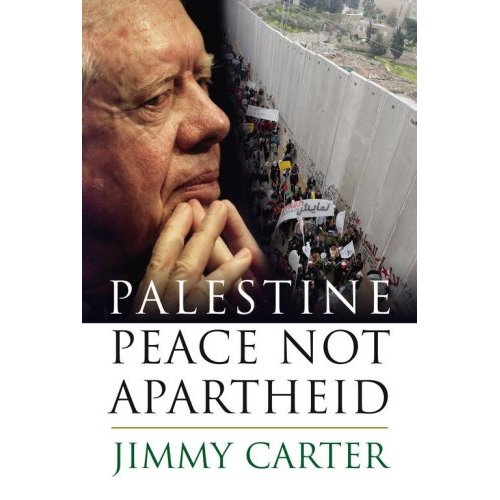
On the other side of the spectrum, former president Jimmy Carter is feeling the heat even before his new book-- entitled "Palestine: Peace not Apartheid"-- was released today. Pro-Israeli groups pounced on the opportunity to start a smear campaign against anyone daring to question Israel's apartheid-like occupation of the Palestine territories. American politicians didn't hesitate to make statements criticizing the book (before reading it) and its author for such a characterization of the Jewish state.

Two key party leaders — Democratic National Committee Chairman Howard Dean, party chairman, and House Minority Leader Nancy Pelosi — and several congressmen issued statements Monday saying that the book, “Palestine: Peace Not Apartheid,” does not represent their views on the Jewish state.

“It is wrong to suggest that the Jewish people would support a government in Israel or anywhere else that institutionalizes ethnically based oppression, and Democrats reject that allegation vigorously,” Pelosi wrote in a statement. “With all due respect to former President Carter, he does not speak for the Democratic Party on Israel.” [h/t www4report]

(Side note: If you just now realized that Nancy Pelosi's position as the new Speaker of the House won't do the Palestine issue any good, feel free to go cry in the corner). The politicians do not even attempt to give the book a chance and wait to read it then refute its arguments. Even this Israeli reporter notes the futility in arguing against characterizing Israel as an apartheid regime (although he goes on to criticize Carter's use of the word in terms of "the context and bigger picture").
Apartheid is the worst word one can use against Israel and stay within the boundaries of legitimacy. Using analogies to Nazi Germany - as some anti-Israel activists have done in the past - is unacceptable. Using words like Occupation is not strong enough to earn any attention. Carter pushed the envelope just a little bit futher, but got the effect he wished to have: Anger, controversy, political turmoil, hurt feelings. Arguing about Apartheid is pointless. There is enough material evidence to prove that apartheid exists in the occupied territories in one form or another. If you argue about the use of this word, you lose. If you argue that Israel is blameless you also lose.
Finally, a lengthy article in the Boston Globe today looks at the dynamics of discussions on this conflict across college campuses in the US. Jake Halpern writes that the issue of Palestine and Israel is simply "Too Hot to Handle", even though more controversial issues such as race and homosexuality are more openly broached without the same intensity among college students.

The question for students and administrators at Brandeis, UC Irvine, Penn State, and other schools is this: Why is it so hard to talk about Israel in an open, civil, and constructive manner? After all, our college campuses have long provided a forum for discussing the nation's most divisive and controversial issues - including date rape, racism, abortion, and gay rights. So why, exactly, is the subject of Israel so difficult to discuss?

The Holy Land has never been an easy topic of conversation. The fact that three of the world's major religions all have a large spiritual stake in the city of Jerusalem, Israel's capital, guarantees that virtually every young person with an opinion has something to say on the fate of this place. But why is the topic especially contentious right now?

The answer in part is that Christian, Jewish, and Muslim college students are more organized than they ever have been - and more outspoken, especially when it comes to Israel.
This is indeed true that many American students are more aware and engaged in what is going on in the region, and have put their energy into organizations that support their views and allow them to express their opinions on the conflict. It is also the case that pro-Israeli student groups receive a lot of funding and training from national organizations such as AIPAC and ADL, in addition to having Hillel's resources at their disposal, despite the fact that the latter is predominantly a religious organization and ideally should not engage in all this politics. The work of pro-Israeli groups is thus more organized and much better funded than that of pro-Palestinian groups which nonetheless are generating a lot of discussion about the occupation and American support for it despite the intimidation they face from some hard-line pro-Israel groups and university administrators.

[photo courtesy: Amazon]
[technorati tags: , , , , , , , ]

Labels: , , , , , , ,

September 16, 2006

Sticks and Stones...On the Pontiff's Words

As if we don't have enough frustration and anger in the Muslim world for the wars, occupation, poverty, unemployment, humiliation, lack of freedoms, and so called terrorism that plague us, the highest authority of the Catholic faith decides that there is a pressing need to reiterate the ignorant and insulting message the Danish cartoons portrayed only a few months ago. And as if we don't have enough people saying we're crazy angry terrorists, a few Muslim lunatics had to go prove the Pope's statements by throwing fire bombs at churches in the West Bank town of Nablus. Do people not think anymore?! Is it really that hard to think twice before saying or doing something that might cause harm to many people around you and many people who listen to you?

The 'cartoon controversy' is still fresh in the memory of most people around the world, especially Muslims. The Prophet Muhammad was defamed in the satirical Danish cartoons with complete disregard for the feelings of 1.6 billion Muslims around the world who consider such drawings offensive at least and blasphemous at best. Millions of Muslims around the world peacefully protested the cartoons and some of course violently protested. It took much effort on the part of the Danish to retract and apologize for the actions of a few of their countrymen, and it took a lot more effort from the Muslim world to begin a dialogue about the important role the Prophet plays in the Islamic faith with the West. Discussions, conferences, and countless dialogues were held in order to bring both sides together to recognize the sanctity of different aspects of religion for followers of different faiths. This is the only positive result of the Danish cartoon controversy.

But just as people are beginning to calm down and realize that discussion and exchange of ideas is the only way to educate ourselves and each other about our beliefs, ideals, and customs, the Pope decides to spark yet another controversy by insulting the most revered figure in the Islamic faith, the Prophet Muhammad.

Muslims around the world have demanded an apology from the pontiff, and rightly so, for his insulting and inflammatory statements. Today, the Pope issued a statement, which most media outlets are still debating as to whether it constitutes an apology or not. The BBC says the Pope has apologized, while CNN says his statement comes short of an apology. [The full text of the statement is here.]

Thank you, Pope Benedict XVI, for "regretting" that your statement "could have sounded offensive" to Muslims around the world. Unfortunately, the damage has been done, yet again. And while most Muslims want an official and personal apology, that is not likely to change the reality of what happened. We all make mistakes, that is true. But we also know that a Pope is given such an important responsibility that he could not mistakenly make such a statement in a well-prepared for speech before a large audience.

And to those individuals who claim to represent me and my religion by attacking sacred churches and burning effigies and flags, please remember that the Prophet would not have, in a million years and in the face of thousands of insults, ever acted this way. His neighbor threw trash in front of his house every single day and the non-Muslims in Mecca insulted him verbally and even abused him physically. He turned the other cheek and prayed that God would forgive them and guide them. The Prophet said, "The strong is not the one who overcomes the people by his strength, but the strong is the one who controls himself in a moment of anger."

I conclude with a very well written editorial in the New York Times today which analyzes the situation very clearly and effectively:

There is more than enough religious anger in the world. So it is particularly disturbing that Pope Benedict XVI has insulted Muslims, quoting a 14th-century description of Islam as “evil and inhuman.”

In the most provocative part of a speech this week on “faith and reason,” the pontiff recounted a conversation between an “erudite” Byzantine Christian emperor and a “learned” Muslim Persian circa 1391. The pope quoted the emperor saying, “Show me just what Muhammad brought that was new, and there you will find things only evil and inhuman, such as his command to spread by the sword the faith he preached.”

Muslim leaders the world over have demanded apologies and threatened to recall their ambassadors from the Vatican, warning that the pope’s words dangerously reinforce a false and biased view of Islam. For many Muslims, holy war — jihad — is a spiritual struggle, and not a call to violence. And they denounce its perversion by extremists, who use jihad to justify murder and terrorism.

The Vatican issued a statement saying that Benedict meant no offense and in fact desired dialogue. But this is not the first time the pope has fomented discord between Christians and Muslims.

In 2004 when he was still the Vatican’s top theologian, he spoke out against Turkey’s joining the European Union, because Turkey, as a Muslim country was “in permanent contrast to Europe.”

A doctrinal conservative, his greatest fear appears to be the loss of a uniform Catholic identity, not exactly the best jumping-off point for tolerance or interfaith dialogue.

The world listens carefully to the words of any pope. And it is tragic and dangerous when one sows pain, either deliberately or carelessly. He needs to offer a deep and persuasive apology, demonstrating that words can also heal.

[technorati tags: , , ,, , ]

Labels: , ,